TraceHound
A better Amazon CloudWatch Logs console in your own AWS account: cost and storage per log group, retention hygiene, Explore, Trace, shared Live Tail and dashboards.
[ P ] LATEST POSTS
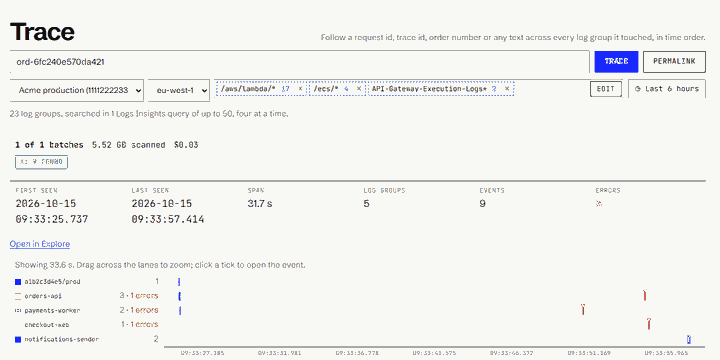
Following one request across every service in CloudWatch Logs
A failed checkout touches API Gateway, three Lambda functions and a container, and each writes to its own log group. Here is how to follow one order number or trace id through all of them with Logs Insights, and how TraceHound puts it on one timeline.
4 min read →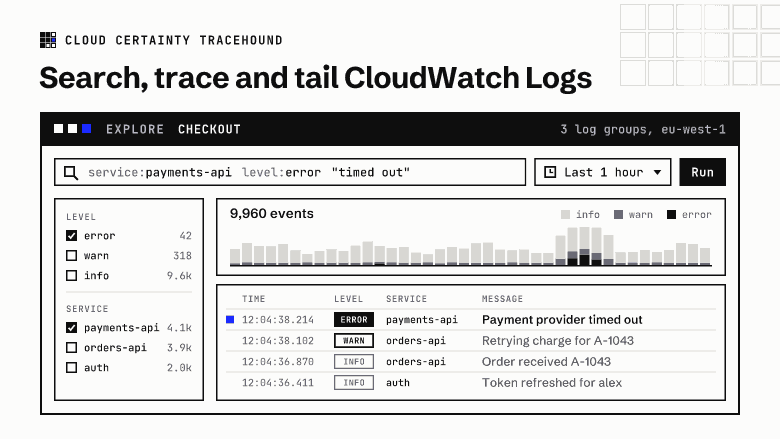
TraceHound: a better CloudWatch Logs console, in your own AWS account
CloudWatch Logs holds most of what your AWS workloads say, but the console leaves you guessing what each log group costs, who may read what and how one request moves through your services. TraceHound answers those questions, and runs in your own AWS account.
4 min read →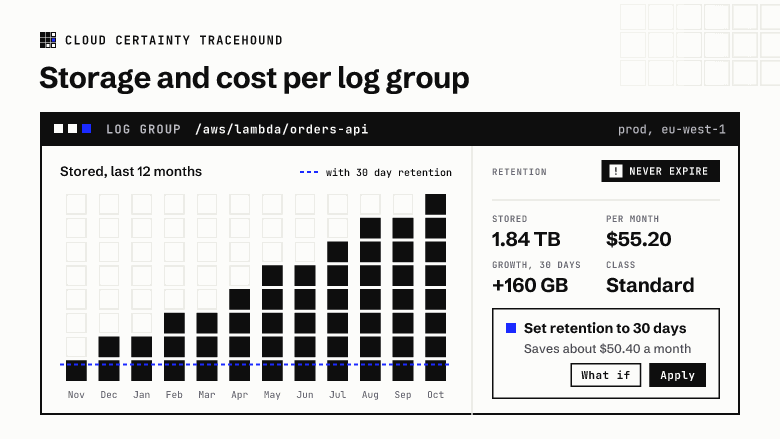
What does each CloudWatch log group cost you?
Your AWS bill shows CloudWatch Logs as a few lines, not as log groups. Here is how to work out what each log group costs in ingestion and storage, why storedBytes alone can't tell you how fast it is growing, and how TraceHound keeps that history for you.
3 min read →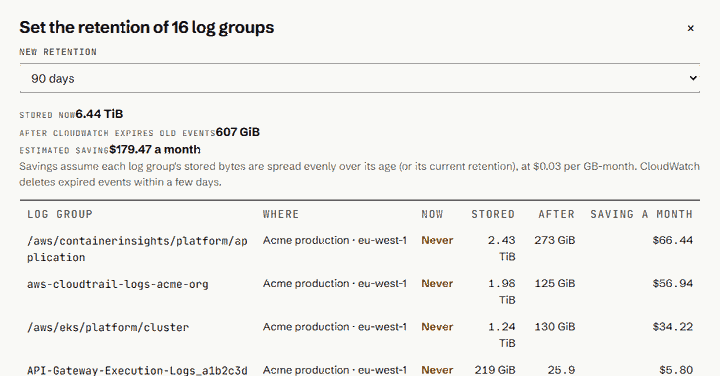
Never expire is the default: cleaning up CloudWatch Logs retention
Every new log group keeps its events for ever, so logs from functions you deleted years ago are still on the bill. Here is how to find never-expire, orphaned and stale log groups, estimate the saving, and set retention on hundreds of them safely.
4 min read →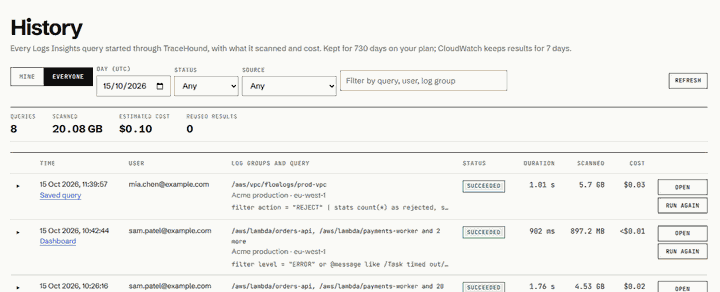
CloudWatch Logs access per team, and what each person's queries cost
Most teams either give everyone every log group or write IAM policies by hand, and nobody knows who ran the query that scanned a terabyte. Here is how TraceHound grants access by log group pattern, enforced by AWS, and records who ran what and what it cost.
4 min read →