Standard support for Redis OSS versions 4 and 5 on Amazon ElastiCache ended on 31 January 2026. Caches still running those versions did not stop working: they moved onto paid Extended Support, and the surcharge appears on the bill from 1 February 2026.
What Extended Support costs
AWS prices Extended Support as a premium on top of the cache's on-demand price:
- 80% in years one and two, from 1 February 2026 to 31 January 2028;
- 160% in year three, from 1 February 2028 to 31 January 2029;
- after 31 January 2029, caches still on Redis OSS 4 or 5 are upgraded to the latest Valkey automatically.
Take a replication group with a primary and one replica whose nodes cost about $300 a month on demand. On Extended Support it costs about $540 a month now, and about $780 a month from February 2028. Nothing about the cache changed; it is the same nodes, the same data and the same traffic.
Redis OSS 6 is next in line. Its standard support ends on 31 January 2027, so the same surcharge will apply to version 6 caches from the following day unless they move first.
Why Valkey is the cheaper way out
You could upgrade to Redis OSS 7, which stops the surcharge. But on ElastiCache, Valkey is priced 20% lower than Redis OSS for node-based caches, and serverless Valkey is 33% cheaper (data stored at $0.084 per GB-hour and $0.0023 per million ECPUs in us-east-1, against $0.125 and $0.0034 for Redis OSS). Valkey is a drop-in successor: clients, commands and data structures stay the same.
For the example above, moving from Redis OSS 5 on Extended Support to Valkey takes the bill from about $540 a month to about $240 a month.
Upgrading in place
ElastiCache can change a replication group's engine from Redis OSS to Valkey in place, keeping the endpoint names and the data:
- From Redis OSS 5.0.6 and later, the cache stays available for reads during the whole upgrade and for writes except for a failover of a few seconds.
- From earlier versions, expect a failover of 30 to 60 seconds while DNS changes.
- Node IP addresses change, so clients that pinned IPs instead of the endpoint name need to reconnect.
- A single-node cluster with cluster mode disabled has to be part of a replication group first; serverless caches change their major engine version.
Test it on a copy first: restore a recent backup into a new cache, upgrade that, and point a test client at it.
Finding every affected cache
The hard part in most organisations is not the upgrade, it is the inventory: which caches, in which accounts and Regions, on which versions, costing what. The ElastiCache console shows one Region at a time and does not show cost.
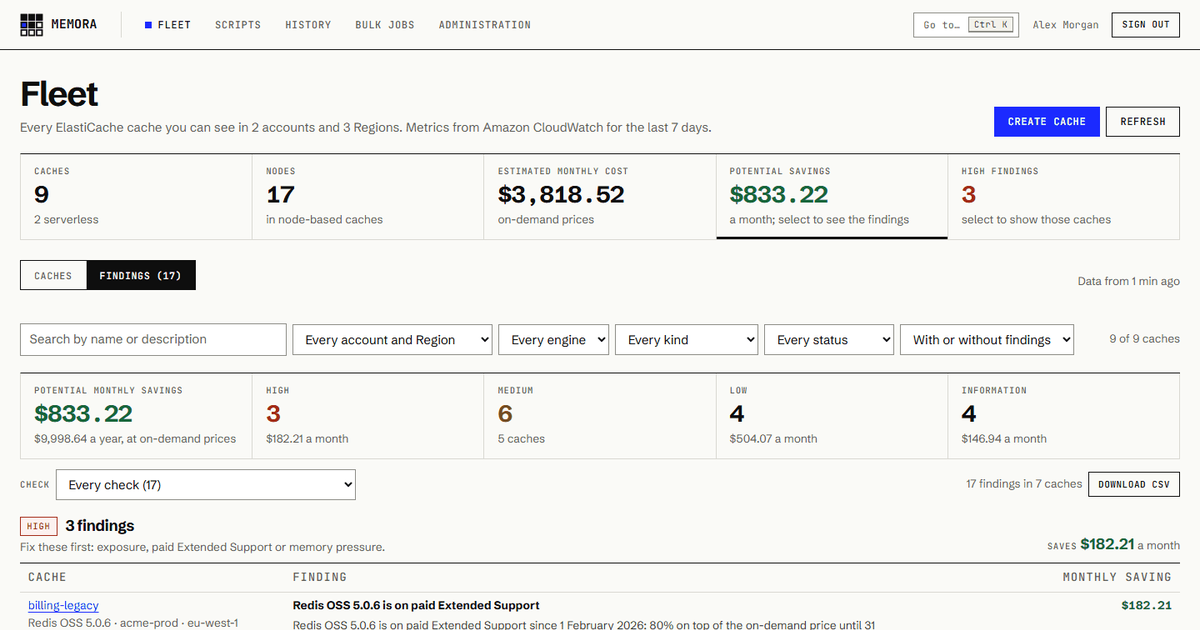
Cloud Certainty Memora lists every cache across your connected accounts and Regions, with its engine, version and an estimated monthly cost from the AWS Price List. Its findings flag each Redis OSS 4 and 5 cache on Extended Support with the surcharge it pays, each Redis OSS 6 cache approaching the end of standard support, and the saving of moving each Redis OSS cache to Valkey, computed so the two do not double count. The findings view adds them up across the fleet and exports to CSV for the team that owns the budget.
On a cache's Configuration tab, someone with the manage permission can then choose Valkey and a version, see the saving next to the button, and confirm. The change goes through ElastiCache with that person's email in CloudTrail and in Memora's audit log.
A short plan
- List every Redis OSS cache and its version, and sort by monthly cost.
- Start with Redis OSS 4 and 5: they are paying 80% more today.
- Upgrade a restored copy first, run your client tests, then upgrade the original in a quiet window.
- Do the Redis OSS 6 caches before 31 January 2027.
Memora is in early access: cloudcertainty.com/memora (opens in a new tab).